
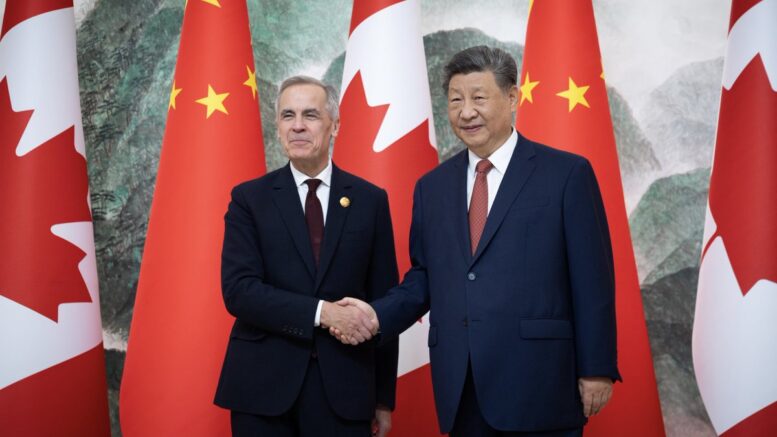
Canada will expand tariff relief on Chinese steel and aluminum products in short supply at home and extend existing exemptions through 2028, as Prime Minister Mark Carney broadens a trade accord with Beijing.
The expansion covers all or part of 23 steel and nine aluminum tariff items for which Canadian supply is insufficient or unavailable, Canada’s federal government said Tuesday after Carney met President Xi Jinping in Shenzhen. In exchange, China will provide additional tariff relief on about $400 million (US$280 million) in Canadian pork, fish and seafood exports.
“Canada and China have recalibrated our relationship to the benefit of citizens in both countries,” Carney said in a statement.
The agreement announced Tuesday eases import costs for Canadian manufacturers that cannot source enough of the specified metals domestically, while preserving the wider tariff framework intended to protect Canadian production. Ottawa’s broader duties on Chinese steel and aluminum remain in place.
U.S. demand
U.S. Trade Representative Jamieson Greer warned in an Aug. 26 CBC interview that tariff relief for Canadian steel and aluminum would require safeguards against foreign metals entering the American market through Canada. Washington wanted Ottawa to align its trade protections to prevent that route, he said.
The White House’s Office of Trade and Manufacturing Policy named Canada among China’s “biggest enablers” in an August assessment of tariff evasion. Chinese exporters were routing goods through third countries and misrepresenting their origin to obtain lower U.S. duties, the office alleged.
Canada imposed a 25% surtax on specified Chinese steel and aluminum imports in October 2024, citing non-market policies and practices that threatened domestic production and investment. The measure remains part of Ottawa’s metals tariff system, alongside separate rules covering steel import quotas and goods containing metal originally made in China.
The exemptions, known as remissions, relieve importers of duties on qualifying products. Existing product-specific relief applies to all importers of the listed goods, while businesses whose products are not covered can request exceptional relief, the Department of Finance says.
January accord
The latest measures build on the countries’ January trade arrangement. Earlier relief covered 66 lines of product-specific remissions and 49 tariff lines of company-specific remissions. Ottawa also added coverage for seven steel, two aluminum and four steel derivative products under that arrangement, Global Affairs Canada said in a background document.
The new two-year extension moves the expiry of existing metals relief from the end of 2026 to the end of 2028. Ottawa tied the additional 32 tariff items to gaps in Canadian supply. The leaders’ announcement didn’t identify individual manufacturers that would benefit.
The broader thaw also affects the battery supply chain. Canada’s January arrangement with China set an initial quota for 49,000 Chinese electric vehicles at a 6.1% tariff. About 16,200 vehicles have entered Canada under the arrangement since March, Global Affairs Canada said.
Separately, Carney said Canada would conduct a trade mission to China in 2027. The renewed relationship has restored access for more than 90% of Canadian trade previously affected by tariff action, representing nearly $7.5 billion in exports, Ottawa says.



Be the first to comment on "Canada widens tariff relief on Chinese metals"